Sustainably Connected
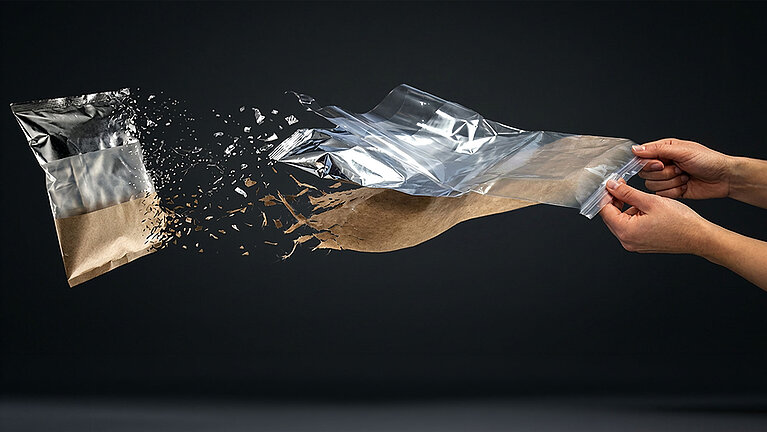
What the Packaging Industry Needs Now
The question is no longer whether sustainable packaging will become the industry standard. With the Packaging and Packaging Waste Regulation (PPWR), the regulatory framework is already in place.
The key challenge now is how quickly the industry can establish the technologies, processes, and partnerships required to implement sustainable packaging concepts economically and at industrial scale. Sustainability is not achieved through individual measures alone, but through the effective interaction of the entire value chain.
A circular Economy can only succeed together
Material manufacturers, converters, machine builders, brand owners, retailers, and recyclers all play a role in determining whether packaging is ultimately recyclable and compatible with a circular economy.
For this reason, all stakeholders must align at an early stage. When requirements from material development, processing, packaging design, and recycling are brought together from the outset, the chances of technical feasibility, economic viability, and successful scaling increase significantly.
Collaboration is therefore becoming the defining competitive factor in a sustainable packaging industry.
New Materials put Processes to the Test
Recyclable mono-material packaging based on polypropylene (PP) and polyethylene (PE) is increasingly replacing complex multi-layer structures. At the same time, the use of post-consumer recyclates (PCR) is growing in order to close material loops and comply with regulatory requirements.
However, these developments also increase production challenges. Variations in material properties can affect processing performance and place greater demands on machinery, quality assurance, and process control.
The success of sustainable packaging solutions therefore depends on more than just material selection. The key question is whether new materials can be processed reliably throughout the entire value chain, from printing and converting to filling, sealing, and ultimately recycling.
Data creates Transparency and Confidence
Alongside new materials, the availability of reliable production and sustainability data is becoming increasingly important.
Companies must be able to demonstrate recycled content levels, process efficiency, and the impact of packaging solutions on resource consumption and circularity. At the same time, this data serves as the foundation for process optimization and investment decisions.
Digital technologies enable continuous monitoring and optimization of production processes. Quality data, predictive maintenance, and automated process analyses help improve both efficiency and sustainability.
As a result, data is evolving into a strategic success factor in packaging production.
Why Sealing Technology is becoming more important
As packaging materials evolve, sealing is moving increasingly into focus. Recyclable mono-materials and PCR-containing films often behave differently from conventional packaging structures and can present challenges for traditional heat-sealing processes.
For packaging manufacturers, this means that sealing technology must ensure reliable seal integrity even when material properties fluctuate or process windows are narrow.
This is where alternative technologies are gaining importance.
Ultrasonic Sealing as an Enabler of Sustainable Packaging
Unlike thermal sealing methods, ultrasonic sealing generates the required energy directly within the sealing area through high-frequency mechanical vibrations.
This enables more reliable processing of sustainable packaging materials while reducing the thermal stress applied to both the packaging and the product.
Key Benefits
- High and reproducible seal quality
- Stable results even within narrow process windows
- Reduced thermal stress on sensitive products
- Excellent suitability for mono-materials and PCR-containing films
- Future-proof technology for emerging sustainable material concepts
As a result, ultrasonic sealing is becoming a key enabling technology for the implementation of circular and recyclable packaging solutions.
Conclusion: The Future Is Connected
Sustainable packaging is not created by individual technologies or materials alone. It emerges when companies connect knowledge, data, and processes across the entire value chain.
Successful packaging concepts combine circular economy principles with economic viability, data-driven process optimization, and reliable production technology.
What Will Sustainable Packaging Look Like Tomorrow?
This was the focus of our live discussion at interpack 2026. Our panel included:
- Jenny Haase (Heyne & Penke Verpackungen GmbH)
- Morito Ito (Fuji Machinery)
- Felix Bischopink (Packiro)
- Micha Augenstein (Herrmann Ultraschall)
Access the recording here: